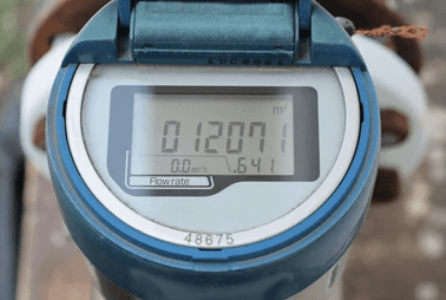
A packed house in the Soweto region of South Africa has just sat down for dinner. With nothing to wash it down. The food was cooked using water from the communal tap some miles away, although the house has a working faucet. The small LED display attached to that faucet, however, shows that the family is allowed 0 liters of water for the rest of the month. The “smart” water meter that has cut off their supply is marketed as a tool for enforcing sustainability, but its negative impacts on disadvantaged communities make it a political tool of continued oppression.
Smart water meters are becoming increasingly prevalent across South Africa in response to the historic issue of water stress and scarcity, most infamously displayed in 2018 as the city of Cape Town began counting down the days until they ran out of water, otherwise known as “Day Zero.” South Africa currently relies on manually read water metering systems that tend to be labor-intensive and inaccurate. The implementation of a smart water management system could curtail these issues, obtaining data in real-time which increases efficiency and reduces company costs (Mudumbe & Abu-Mahfouz, 2015). Ease of use for the customer, reduced water demand, the ability to more accurately predict demand, and a reduction of greenhouse gas emissions have also been cited as positives (Monks, Stewart, Sahin, & Keller, 2019).
However, this technology enforces strict limitations on water consumption and is met with extreme opposition from local communities, especially those of lower socioeconomic status (Amankwaa, Heels, & Browne, 2023). An issue of non-payment in poorer neighborhoods has caused the government and the private sector to label these citizens as lacking “civic virtue,” when in reality they simply do not have the means to pay (Loftus, 2006). The result is the forced installation of smart water meters in these neighborhoods, which benefits corporations but infringes on the basic human right to sufficient water consumption. These poorer neighborhoods also happen to reflect the racial divides established during apartheid, an era categorized by the systematic oppression of non-white residents that the country is still recovering from.
In line with the “Free Basic Water Policy” of 2001, smart water meters allot 6000 free liters of water per month per household. WHO claims that 50-100 liters of water per day per person are needed to meet basic needs (United Nations, 2015), meaning 6000 liters per month could sustain a maximum of 4 people. Unfortunately, household size is not considered in the water allotment despite households averaging as many as 13 members in many poorer neighborhoods (Dugard, 2010). After the free 6000 liters are supplied, the meters are designed to shut off automatically and only turn back on if the household pays substantially for it, which few can afford (Loftus, 2006). Otherwise, they must wait until the first of the month for more free water, which may be weeks away. These new policies only exacerbate the problem of accessibility. Households that lack the financial means to pay for the water necessary to support their large families are left with few options (Von Schnitzler, 2008). Communal water sources are often miles away, a commute that takes time away from necessary paid work.
One neighborhood, Soweto in Johannesburg, responded through protest, physically blocking the installation of the meters. Eventually, the case was brought to the city’s court, which recognized racial, class, administrative, and gender-based discrimination and declared pre-paid meters unlawful (Dugard, 2010). This conflict in South Africa revealed how smart water meters can function as a “techno-political device” used to oppress black and brown communities struggling in the aftermath of apartheid (Von Schnitzler, 2013). Given the negative consequences of a lack of clean water, including higher rates of disease (Dugard, 2010), prepaid meters in areas of little to no income infringe on the rights to dignity and health.
Not only does this technology infringe on basic human rights, but it doesn’t even live up to its claims of sustainability. The highest contributor to unbilled water losses in South Africa is actually meter leaks that worsen with age, demonstrating that innovation should be focused on the design of the meter rather than limiting consumption (Bheki, S., Rimer, S., Ouahada, K., Mikeka, C., & Pinifolo, J., 2016). The technology has been accused of aspiring to be “smart” even before becoming functional (Joshi, Bardzell, J, & Bardzell, S, 2021). This indicates that installing these pre-paid water meters was more about withholding water from poor communities like Soweto than water conservation (Ncube, Sibanda, Kagoda, & Bhagwan, 2022), perpetuating the inequalities that pervade South Africa in the aftermath of its apartheid era. Smart water meters highlight how methods of oppression have become more discrete with advancing technology, signaling a need for deeper and more critical analysis of proposed innovations to avoid a similar fate.
Bibliography
Amankwaa, G., Heeks, R., & Browne, A. (2023). Smartening up: User experience with smart water metering infrastructure in an African city. Utilities Policy, 80, 101478. https://www.sciencedirect.com/science/article/pii/S0957178722001424
Bheki, S., Rimer, S., Ouahada, K., Mikeka, C., & Pinifolo, J. (May 2016). Smart Water Leakage Detection and Metering Device. Department of Electrical and Electronic Engineering Science, University of Johannesburg. https://www.researchgate.net/publication/305997859_Smart_water_leakage_detection_and_metering_device
Dugard, J. (2010). Civic Action and Legal Mobilization: The Phiri Water Meters Case. In J. Handmaker & R. Berkhout (Eds.), Mobilizing Social Justice in South Africa: Perspectives from Researchers and Practitioners (pp. 71-99). Pretoria University Law Press. https://www.researchgate.net/publication/265104232_CIVIC_ACTION_AND_LEGAL_MOBILISATION_THE_PHIRI_WATER_METERS_CASE/link/56b0888308ae9ea7c3b00fd9/download?_tp=eyJjb250ZXh0Ijp7ImZpcnN0UGFnZSI6InB1YmxpY2F0aW9uIiwicGFnZSI6InB1YmxpY2F0aW9uIn19
Loftus, A. (November, 2006). Reification and the Dictatorship of the Water Meter. Antipode, 38(5), 1023-1045. https://www.researchgate.net/publication/227674452_Reification_and_the_Dictatorship_of_the_Water_Meter
Joshi, T., Bardzell, J., & Bardzell, S. (October 2021). The Flaky Accretions of Infrastructure: Sociotechnical Systems, Citizenship, and the Water Supply. Proceedings of the ACM on Human-Computer Interaction, 5, 1-27. https://www.researchgate.net/publication/355397825_The_Flaky_Accretions_of_Infrastructure_Sociotechnical_Systems_Citizenship_and_the_Water_Supply
Monks, I., Stewart, R. A., Sahin, O., & Keller, R. (2019). Revealing Unreported Benefits of Digital Water Metering: Literature Review and Expert Opinions. Water, 11(4), 838. https://doi.org/10.3390/w11040838
Mudumbe, M.J., & Abu-Mahfouz, A. (2015). Smart Water Meter System for User-Centric Consumption Measurement. Meraka Institute, Council for Scientific and Industrial Research. https://www.researchgate.net/publication/282643910_Smart_water_meter_system_for_user-centric_consumption_measurement
Ncube, M., Sibanda, F., Kagoda, P., & Bhagwan, JN. (2022). The State of Domestic Water Meter Management. Water Research Commission. [Science Brief]. chrome-extension://bdfcnmeidppjeaggnmidamkiddifkdib/viewer.html?file=file:///Users/erinczelusniak/Downloads/Science%20brief_The%20State%20of%20Water%20Metering%20in%20South%20Africa.pdf
UN-Water Decade Programme on Advocacy and Communication and Water Supply and Sanitation Collaborative Council. The Human Right to Water and Sanitation [Media Brief]. https://www.un.org/waterforlifedecade/pdf/human_right_to_water_and_sanitation_media_brief.pdf
von Schnitzler, A. (2008). Citizenship Prepaid: Water, Caculability, and Techno-Politics in South Africa. Journal of South African Studies, 34(4), 899-917. https://www.jstor.org/stable/40283199
von Schnitzler, A. (2013). Traveling Technologies: Infrastructure, Ethical Regimes, and the Materiality of Politics in South Africa. Cultural Anthropology, 28(4). https://www.researchgate.net/publication/259548270_Traveling_Technologies_Infrastructure_Ethical_Regimes_and_the_Materiality_of_Politics_in_South_Africa
 Erin Czelusniak
Leave a comment